

Balance, Not Restriction: A Healthier Way Through the Holidays
Every year the same advice shows up around the holidays: skip the sugar, pass on the cake, say no to the cookies and the second helping. A whole season gets turned into a list of things you're not supposed to do.
We don't believe in that, and we don't think your body needs it either. That doesn't mean eat whatever you want, as much as you want. It means the answer isn't punishment. It's support.

You Are Not Your Mind (And You Are Not What You Think)
Meet Yi: Your Mind, Your Ego, Your Avatar's Manager
In Chinese medicine, your mind has a name: Yi. Yi is your conscious mind — the narrator in your head, the voice that thinks, focuses, plans, worries, and tells the story of your life all day long. You might even call it your ego.
In Taoist terms, Yi supports the ego and the conscious mind for the manifestation of this current life — the 3-D avatar you're living in right now. And let's be fair to Yi: that's an important job. Your avatar needs a manager. Someone has to remember appointments, chew over decisions, learn from mistakes, and keep the daily show running. Yi does all of that, tirelessly.
But a manager is not the owner. A narrator is not the author. And a tool, no matter how brilliant, is not the master.
Decisions made from Yi alone — from the ego's fears, habits, and chatter — aren't the deepest reflection of who you are. They're the avatar talking, not the soul. When Yi runs the show, life starts to feel like a loop: the same worries, the same reactions, the same story told louder and louder, as if volume could turn it into truth.

Meet Your Five Spirits: The Inner Team Running Your Whole Life
Imagine a theory of who you are that begins before you existed — in a vast, quiet nothingness called Wu, holding the potential for everything. In one flash of light, five spirits gathered in that nothingness, and you came into being. Those five spirits never left you. They've been with you ever since, quietly shaping how you think, feel, dream, grieve, and gather your will.
They're called the Five Spirits, or Wu Shen, and each one lives in a different organ system, runs different parts of your body, handles a different job, and carries a different emotion. When they're all doing well, you feel like yourself: clear, creative, grounded, brave, and at ease. When one of them is struggling, life starts to feel off in a very specific way — and that's actually great news, because it tells you exactly where to look.

What Are We Asking Our Children to Digest?
Eastern medicine, childhood development, and the importance of protecting what enters our minds
By Dr. Patricia Nichols
We spend a great deal of time thinking about what we feed our children. We read ingredients, consider nutrients, and notice when certain foods leave them uncomfortable.
But what about everything else they consume?
The arguments playing on television. The frightening images passing across a screen. The constant noise, rapid transitions, and adult conversations they cannot yet understand. These experiences enter their world, too.
What we take in through our senses deserves our attention. Nourishment extends beyond the dinner table.
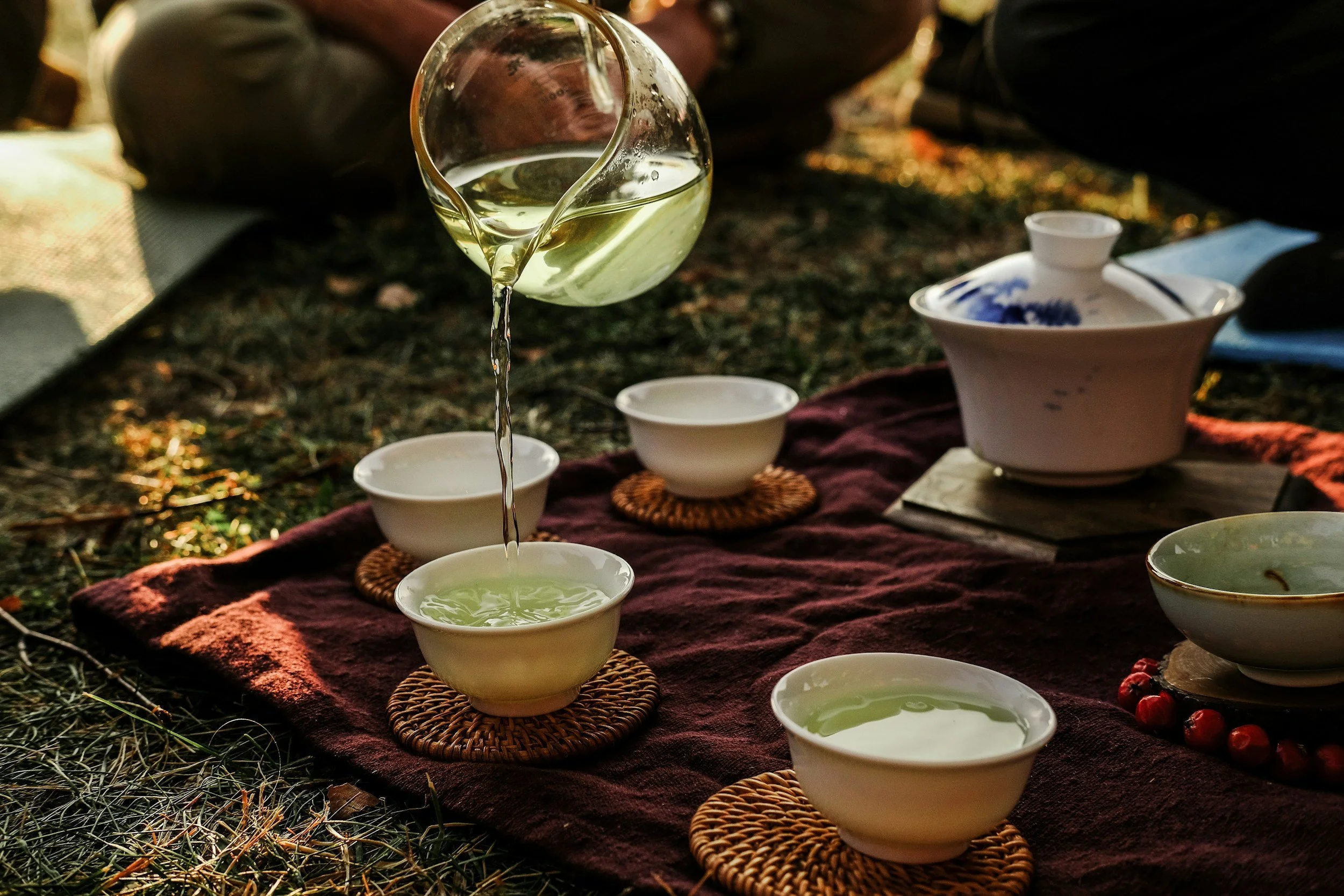
Tea and Qi: What Your Cup Is Really Doing for You
There's an old Chinese saying we love around here: "Better to be deprived of food for three days than tea for one." We won't ask you to skip meals, but we do think it's worth looking a little closer at that cup you reach for every day.
In Chinese medicine, tea isn't just a drink. It's one of the gentlest herbal medicines there is, and it's been used that way for thousands of years. The poet Li Yu wrote in The Art of Tea that tea "tempers the spirit, harmonizes the mind, dispels lassitude and relieves fatigue, awakens the thought and prevents drowsiness." Not bad for some leaves and hot water.

Ancient Roots, Modern Medicine: How Two Healing Traditions Work Together
There is something special about a practice that has been passed from one healer to the next for thousands of years. Long before hospitals, labs, and imaging, people were paying close attention to the body, the seasons, food, plants, sleep, and emotions, and they were learning how all of it fits together.
Today we have access to remarkable medical technology. We also have that ancient wisdom, still here and still being used.
At The Clinical Convergence, we don't see these as competing paths. We see two healing traditions that are each needed, and that are especially good when they work together.

Why Oriental Medicine Rarely Says “Always”
“Is this food good for me?” “Is this symptom caused by stress?” “Is cold weather bad for my body?”
The most honest answer is often: It depends.
That can sound unsatisfying when we want a clear rule.
But in Oriental medicine, context is part of the answer. A symptom is considered alongside the person experiencing it, the season, their habits, their history, and what else is happening in the body.
Relationships matter because the same thing can have a different effect under different conditions.

A Fall Wellness Reset: Honoring the Season of Letting Go
In Chinese medicine, fall is a season of letting go, turning inward, and protecting our energy. As the days grow shorter and drier, simple practices such as warm meals, deeper rest, gentle movement, breathwork, and emotional reflection can help us transition into the season with more steadiness and resilience.

Gray Hair & the Wisdom of Becoming
There is a point in life when the mirror starts telling a slightly different story.
Maybe you notice one silver hair near your temple. Then a few more. Maybe your ponytail feels a little thinner than it used to, your curls have changed their mind about what they want to do, or your hair feels drier and more delicate than it once did. Maybe your scalp shows a little more at the crown, or you are finding more hair in the shower drain than usual.
For many women, these changes begin around perimenopause and menopause, when changing hormones can affect hair texture, growth, density, and shedding.
And while it is completely normal to want to care for your hair, I think it is also important to say this clearly: aging is not a bad thing. Gray hair is not a failure. A softer face, changing body, silver strands, and a different rhythm of energy are not signs that you are doing life wrong.

Detox Done Differently: Why Slow, Supported Detoxification Is Better Than Going Hard and Fast
“Detox” has become one of the most overused and misunderstood words in wellness.
Juice cleanses. Fasting. Detox teas. Supplements. Colon cleanses. Liver flushes. Parasite protocols.
We are often sold the idea that if a little detoxification is good, more must be better. If three days is helpful, seven days must be better. If one supplement supports detoxification, five supplements should work even faster.
But the body does not necessarily work that way.
At The Clinical Convergence, we take a different approach.
Detoxification should not be about forcing the body to eliminate as much as possible, as quickly as possible. It should be about supporting the body’s natural ability to process and eliminate what it no longer needs at a pace the individual can safely handle.
And sometimes, the safest “detox” is not detoxing YET at all.

Experience the Benefits of Acupuncture—Without Needles
Introducing Aroma Acupoint Therapy™ (AAT)
Have you been curious about acupuncture but hesitant about needles? You are not alone. Some people feel anxious around needles, prefer a gentler first step, have sensory sensitivities, or simply want a deeply relaxing treatment experience.
At our clinic, we believe that care should meet you where you are. You do not have to push through a fear of needles to receive thoughtful, individualized support rooted in Chinese medicine. Aroma Acupoint Therapy™ (AAT) offers a soothing, needle-free way to engage acupuncture points while incorporating the therapeutic qualities of carefully selected essential oils.
This restorative treatment combines the wisdom of acupuncture-point therapy with the sensory and botanical support of aromatherapy. It is gentle enough for many needle-sensitive patients, children, and people who are depleted, overwhelmed, or simply seeking a quieter approach to healing.

Finding Balance in a Toxic World
By Amy Lupton
When my daughter was born and diagnosed with food allergies, it completely changed how I looked at food and everyday products.
Suddenly, every ingredient label felt like a potential threat.
I remember days where it almost made me a little crazy, I worried that everything could hurt her, from what was in our pantry to the soap by the sink.

NADA Protocol: How Five Tiny Ear Acupuncture Points Can Help Calm the Nervous System
If you've ever felt like your body is "stuck" in survival mode—constantly anxious, easily startled, unable to relax, or emotionally overwhelmed—you are not alone. For many people living with chronic stress, PTSD, anxiety, trauma, or burnout, the nervous system simply loses its ability to return to a calm, regulated state.
One of the most effective and well-known acupuncture treatments for restoring this balance is the NADA Protocol, also known as the National Acupuncture Detoxification Association Protocol.

The Five Spirits. Which One Are You?
Last week, we introduced Qi, Yin-Yang, and meridians, the foundational language of Chinese medicine. Now, before we go deeper into each of the Five Spirits, let's answer the question most people are really asking: which one am I?

What Is Qi? A Simple Introduction to Chinese Medicine
Before we go any deeper into Chinese medicine, let's answer the question almost everyone asks first: what actually is this stuff?
Qi: Your Vital Energy
Qi (pronounced "chee," sometimes spelled chi) is the foundational concept of Chinese medicine. It's usually translated as "vital energy" or "life force" — the animating force behind everything your body does: movement, warmth, digestion, healing, thought. Where Western medicine tends to study the body's separate parts, Chinese medicine starts from the opposite direction: it assumes everything is connected by this one flowing energy, and that health is simply what happens when Qi moves freely, while illness is what happens when it gets blocked, deficient, or stuck.
There are two main sources of your Qi:
Yuan Qi: The Qi you inherit from your parents at conception — your constitutional starting reserve. It's stored in the Kidneys, and once used up, it can't be replaced, which is why Chinese medicine places so much emphasis on protecting it.
Postnatal Qi: The Qi you generate every day from the food you eat and the air you breathe. This is the Qi you can actively build and replenish through diet, breath, sleep, and lifestyle.

The Vagus Nerve: Where Fascia, Mitochondria, and Mind Meet
Part 4 of our 5-part series, The Body Talks: Fascia, Mitochondria & Neuro-Wellness
This week, we meet the interpreter. The Vagus Nerve.
Running like a wandering river from the base of your brain, down through your neck, branching into your heart, lungs, gut, liver, kidneys, and reproductive organs, is a single cranial nerve so important to whole-body communication that the ancient Greeks named it from the Latin word for wanderer: vagus.
The vagus nerve is the missing link in nearly every modern wellness conversation. And it is the precise place where fascia, mitochondria, and the nervous system sit down at the same table and finally start talking to each other.
What the vagus nerve actually does
The vagus nerve is the longest cranial nerve in your body and the primary highway of your parasympathetic nervous system — the branch responsible for "rest, digest, and repair."
When your vagus nerve is well-toned, you sleep deeper, digest more efficiently, recover from stress faster, hold less chronic inflammation, and feel genuinely safer in your own body. When it is dysregulated, almost every system downstream begins to struggle.
The measurable proxy for vagal tone is heart rate variability, or HRV, the tiny variations in time between each heartbeat. High HRV signals a flexible, well-regulated nervous system. Chronically low HRV is one of the most reliable predictors of nearly every modern chronic disease.

Your Brain on Sound and Light: The Science of BrainTap and Neuro-Entrainment
Part 3 of our 5-part series, The Body Talks: Fascia, Mitochondria & Neuro-Wellness
So far in this series, we have traveled through two layers of your body's communication network. In Part 1, we met your fascia, the 250-million-nerve-ending sensory web that speaks pressure, tension, and emotion all day long. In Part 2, we went deeper, all the way into your mitochondria, and explored how red light therapy speaks directly to the energy-producing machinery inside every cell.
Today we turn to the third layer. The one that sits between the architecture and the energy, and quietly conducts the whole orchestra.
Your nervous system.
And here is where things get genuinely fascinating, because your brain has a property that, once you understand it, changes how you think about wellness forever. Your brainwaves can be guided. Gently, safely, and measurably. With nothing more than the right combination of rhythmic sound and synchronized light.
This is the science of neuro-entrainment, and it is the principle behind one of our most beloved modalities at Clinical Convergence: BrainTap.

The Father's Day Weight-Loss Conversation Nobody Is Having
Why Many Men Lose Weight Quickly on GLP-1s—But Gain It Back Just As Fast
As Father's Day approaches, it's worth acknowledging something that often goes unspoken:
Many men are carrying far more than extra weight.
They are carrying responsibility.
The responsibility of providing for a family. Managing finances. Supporting a spouse. Raising children. Meeting expectations at work. Solving problems. Protecting the people they love.
While society often celebrates a man's ability to "push through," the body keeps score.
At Clinical Convergence, we've observed that many men respond remarkably well to GLP-1 medications. In fact, men often lose weight faster than women during the initial stages of treatment.
Yet many of those same men eventually hit a plateau, or experience rapid weight regain after discontinuing treatment.
Why?
Because weight is often not the primary problem.
It is the symptom.

GLP‑1 Meds—Why Some Bodies Respond and Others Don’t
You’ve heard about Ozempic, Wegovy, Mounjaro, and Zepbound. The craze is real, and getting real results.
But here’s the thing almost no one explains: GLP‑1 is not just a drug class, it’s a hormone your body already makes.
At Clinical Convergence, we care less about chasing the latest injection and more about restoring the way your body is meant to use GLP‑1 to regulate appetite, blood sugar, inflammation, and weight.
This might mean getting a low-dose GLP-1 to help with inflammation and weight loss, while concentrating on building your natural GLP-1 rhythm back up. This might mean only using natural herbal GLP-1 support, using nutrition and lifestyle.
That is the beauty of doing it the way the patients body works and needs, after a consultation and careful consideration of your body type.
This article walks through what GLP‑1 actually is, how the meds work, why they help some people so much, why others barely respond, and how body type, tissue quality, and Chinese medicine patterns can help explain the difference.

Light as Medicine
How Red Light Therapy Recharges the Powerhouses Inside Every Cell
Part 2 of our 5-part series, The Body Talks: Fascia, Mitochondria & Neuro-Wellness
Last week, we introduced your fascia as the body's largest sensory organ, the architecture of how your body communicates with itself. This week, we go one layer deeper. Past the connective tissue, past the muscle, past the cell membrane, all the way down to the tiny structures inside every cell that decide whether you wake up feeling vibrant or depleted.
Welcome to your mitochondria. And welcome to the surprising fact that one of the most powerful tools we have for upgrading them is something as ancient as sunlight.
If you have ever stepped outside on a clear morning and felt your whole body exhale, you already understand this intuitively.
Light is not just a visual experience. It is a nutrient.
And specific wavelengths of red and near-infrared light, delivered in clinical doses, can do something remarkable: they can directly speak to the energy-producing machinery inside your cells and tell it to wake up.
This is the science of photobiomodulation, and it is one of the most exciting frontiers in functional medicine today.