
Your Brain on Sound and Light: The Science of BrainTap and Neuro-Entrainment
Part 3 of our 5-part series, The Body Talks: Fascia, Mitochondria & Neuro-Wellness
So far in this series, we have traveled through two layers of your body's communication network. In Part 1, we met your fascia, the 250-million-nerve-ending sensory web that speaks pressure, tension, and emotion all day long. In Part 2, we went deeper, all the way into your mitochondria, and explored how red light therapy speaks directly to the energy-producing machinery inside every cell.
Today we turn to the third layer. The one that sits between the architecture and the energy, and quietly conducts the whole orchestra.
Your nervous system.
And here is where things get genuinely fascinating, because your brain has a property that, once you understand it, changes how you think about wellness forever. Your brainwaves can be guided. Gently, safely, and measurably. With nothing more than the right combination of rhythmic sound and synchronized light.
This is the science of neuro-entrainment, and it is the principle behind one of our most beloved modalities at Clinical Convergence: BrainTap.
A short tour of your brainwaves
Your brain is electric. Every thought you have ever had, every emotion you have ever felt, every moment of focus, fear, sleep, or insight has corresponded to a particular pattern of electrical activity oscillating across your neurons. These patterns are called brainwaves, and they cluster into five main bands:
Delta (0.5 – 4 Hz) — deep, dreamless sleep. The state of cellular repair and growth hormone release.
Theta (4 – 8 Hz) — meditation, deep relaxation, creativity, the edge of sleep, emotional processing.
Alpha (8 – 12 Hz) — calm, awake, present. The "flow" state. Reduced anxiety. Open to learning.
Beta (12 – 30 Hz) — focused, alert, problem-solving. Also, when sustained too long, the wave of anxiety, hypervigilance, and burnout.
Gamma (30 – 100 Hz) — high-level cognition, memory consolidation, peak awareness. Increasingly studied for its role in brain health and longevity.
Most modern adults, especially women juggling careers, caregiving, and the demands of midlife, spend far too much of the day stuck in high beta. The nervous system never gets the signal that it is safe to drop into the slower, more restorative waves where actual healing happens. Over time, that imbalance shows up everywhere: poor sleep, racing mind, shallow breath, hormonal disruption, gut issues, brain fog, and a creeping sense that you are running on fumes even though you have not slowed down enough to notice.
This is exactly the problem neuro-entrainment was designed to solve.
The frequency-following response
Here is the elegant phenomenon at the heart of all of this. When your brain is exposed to a steady, rhythmic external stimulus — a pulse of light, a beat of sound, or both at once, your neural oscillations naturally synchronize to it. This is called the frequency-following response, and it has been documented in neuroscience for decades.
If a stimulus pulses at 10 Hz, your brain begins to mirror that 10 Hz pattern. Pulse at 4 Hz, and your brain starts to slip toward theta. Pulse at 40 Hz, and gamma-band activity activates. The brain is, in essence, a tunable instrument, and rhythmic input is one of the most reliable tuning forks we have.
BrainTap takes this principle and refines it into a complete clinical experience. The system uses three layered technologies working in concert (BrainTap science overview):
Binaural beats — slightly different tones delivered to each ear, which the brain perceives as a single rhythmic frequency, driving the frequency-following response.
Isochronic tones — single tones that pulse on and off at a precise rhythm, providing additional rhythmic anchoring without requiring headphones.
Photic stimulation — soft, synchronized pulses of light delivered through specially designed eyewear, engaging the visual cortex and amplifying the entrainment effect.
Layered together with a guided audio script, the result is a 20-minute experience that gently and reliably guides your nervous system into a chosen state: alpha for calm focus, theta for deep relaxation and emotional processing, delta for sleep preparation, or gamma for cognitive enhancement.
What the clinical data actually shows
This is not aspirational wellness language. It is measurable physiology. The research base on BrainTap and audio-visual entrainment has grown considerably in the last few years.
A clinical trial involving 100 adult volunteers found that a single BrainTap audio-visual entrainment session significantly increased heart rate variability and parasympathetic activity while decreasing stress index and heart rate (summarized in Top Doctor Magazine, 2026). Another study involving 47 health students showed that a single 20-minute session significantly improved HRV, reduced overactive blood flow in the prefrontal cortex (the rumination center), and balanced autonomic activity.
Specifically, BrainTap's published clinical data shows that a single session can produce (BrainTap science page):
38.5% improvement in stress index
27.3% improvement in overall neurological markers
Significant increases in heart rate variability — the gold-standard biomarker of nervous system flexibility
And on the sleep side, the results are equally compelling. A 2026 controlled trial published in Bioinformation using delta-wave BrainTap sessions reported significant improvements in sleep score, deep sleep percentage, and reduced nocturnal awakenings (PMC13058366). A separate study with coal miners under chronic stress showed a 70% increase in deep sleep within three weeks of consistent use — results that typically require six weeks of conventional sleep hygiene to produce.
For a balanced, peer-reviewed look at the broader binaural beats literature, a 2023 PLOS ONE systematic review confirmed that brainwave entrainment can produce measurable effects on anxiety, memory, and attention, while also noting the areas where more research is still needed (PMC10198548). Science is rarely tidy, but the trajectory here is unmistakable.
Why this matters: the parasympathetic gateway
Everything we want our wellness work to deliver, deep sleep, hormonal balance, digestive healing, fertility, calm focus, resilient mood, robust immunity, lives on the other side of one nervous system shift: moving out of sympathetic (fight-or-flight) and into parasympathetic (rest, digest, repair).
You cannot heal in fight-or-flight. Your body simply will not allocate energy to repair and restoration when it believes you are under threat. And here is the catch: the modern world, with its emails and group chats and traffic and news feeds and 11 p.m. blue light, is producing a low-grade threat signal in your nervous system almost constantly. Most of us are walking around in mild sympathetic activation as a baseline, and we have forgotten what regulated even feels like.
BrainTap is one of the most efficient parasympathetic on-ramps we have ever found. Twenty minutes. Closed eyes. Soft light, gentle sound, intentional silence in your own head. And your nervous system, finally given a clear external signal, follows the path of least resistance back to calm.
Especially for women in midlife
If you are navigating perimenopause, menopause, or simply the cognitive load of running a complex life, you may already have noticed that your stress threshold has shifted. Things that used to roll off your back now lodge somewhere in your chest. Sleep that used to come easily now feels rationed. The "wired and tired" feeling becomes a daily companion.
This is not in your head. It is in your nervous system. Estrogen and progesterone are deeply involved in regulating GABA, serotonin, and the parasympathetic response itself. As those hormones fluctuate and decline, the nervous system loses some of its built-in resilience, and it needs more explicit support to find its way home.
BrainTap is one of the kindest, most accessible forms of that support we have found. It does not require willpower. It does not require you to "be good at meditation." It simply requires you to lie down, put on the headset, and let the science do what it knows how to do.
What a BrainTap session looks like at Clinical Convergence
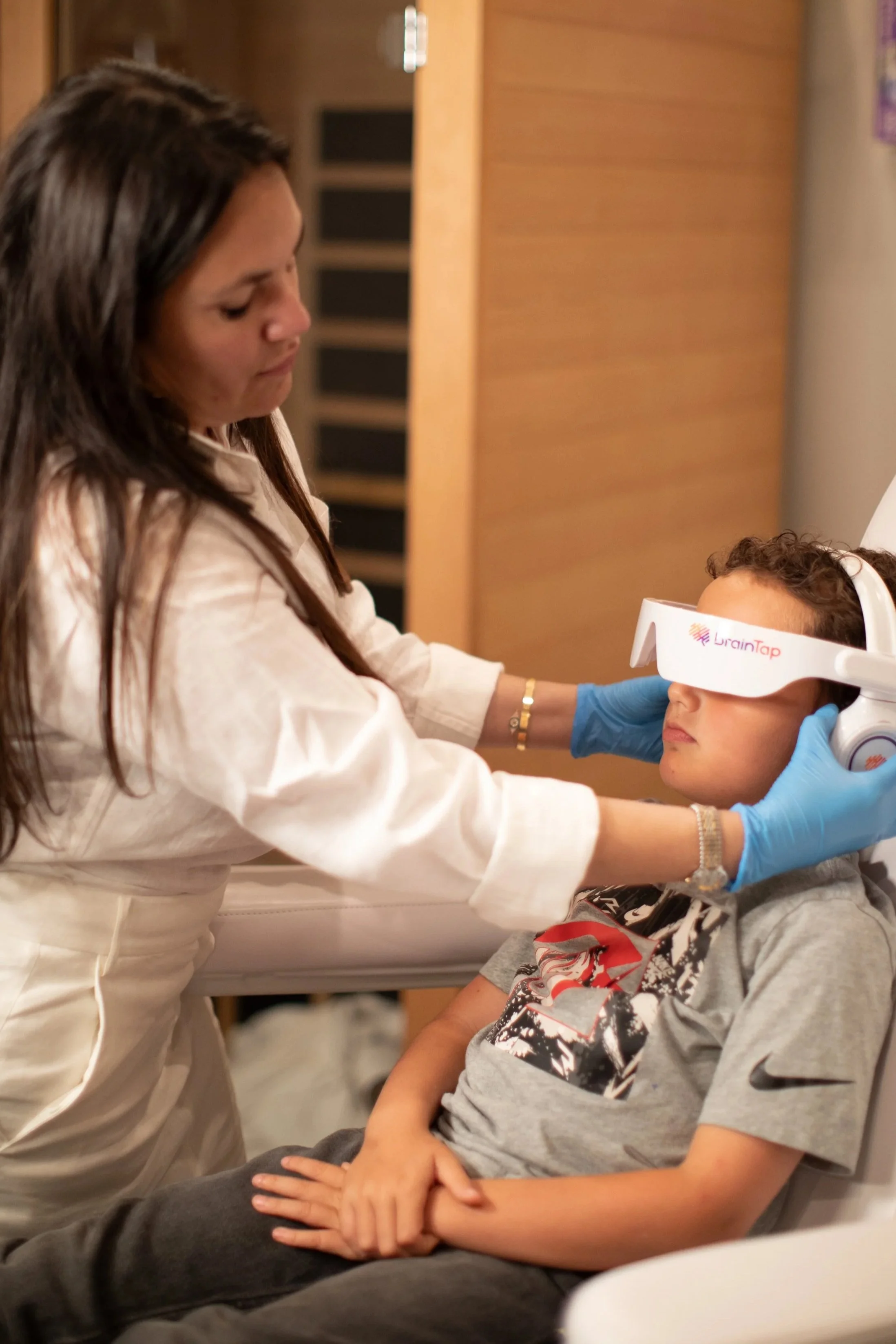
When you come in for a BrainTap session at the clinic, you settle into a reclining chair, slip on the BrainTap headset (sound + soft light eyewear in one), and we select a session matched to what your nervous system needs that day. Some clients come in needing the deep parasympathetic dive of a theta session. Others need the cognitive clarity of an alpha-beta cycle. Many use it before sleep to reset, before a big presentation to focus, or after a stressful week to detox the nervous system.
Twenty minutes later, you sit up softer, clearer, more anchored in your own body. Many clients describe it as the cleanest "reset" they have ever experienced.
We also love stacking BrainTap with our other modalities. Pairing it with acupuncture deepens the parasympathetic shift. Following red light therapy with BrainTap gives the cellular reset a nervous-system layer to settle into.
Looking ahead
In Part 4, we will tie all three layers together through the vagus nerve, the wandering nerve that makes fascia, mitochondria, and brainwaves talk to each other. And in Part 5, we will pull it all into one unified Convergence Protocol you can experience inside the clinic and bring home with you.
For now, here is the invitation. Your nervous system has been listening for a clear signal for a long time. It has been straining to hear it through the noise of modern life, through screens and obligations and a culture that mistakes burnout for productivity. BrainTap is, in many ways, a love letter back to your nervous system. A clear, rhythmic, calmly delivered message that says: you are safe now. You can let go.
Your brain is exquisitely designed to listen.
